Industrial facilities have security requirements that residential and standard commercial properties simply do not share. A manufacturing plant, a logistics hub, a utility yard, a fuel storage facility or a construction staging area all represent environments where perimeter security is not a matter of aesthetics or neighborhood compliance. It is an operational necessity that protects assets, manages liability, controls access and in many cases satisfies regulatory or insurance requirements that the facility cannot afford to fall short of.
Choosing the right chain link fencing system and gate operator configuration for an industrial facility is a decision that deserves more careful consideration than most property managers give it. The wrong gauge of chain link, an undersized gate operator or a poorly designed access control layout can undermine the security investment entirely, create operational bottlenecks that slow down daily workflows and require expensive modifications down the road.
This article is designed to help industrial facility managers, general contractors and property owners understand what to look for when specifying chain link fencing and gate operators for a serious industrial security application.
Why Chain Link Remains the Standard for Industrial Perimeter Security
Before getting into the specifics of gauge, height and gate operators, it is worth understanding why chain link fencing has remained the dominant choice for industrial perimeter security across industries and decades despite the availability of other fencing materials.
The answer comes down to a combination of factors that no other fencing product fully replicates at an industrial scale. Chain link is strong, transparent, adaptable to virtually any terrain, available in configurations that meet the most demanding security specifications and cost-effective at the kind of linear footage that large industrial properties require. It can be topped with barbed wire, razor wire or other deterrents. It can be integrated with security lighting, surveillance systems and electronic access control. And it performs consistently in the kinds of harsh environments, including chemical exposure, extreme heat and coastal salt air, that would compromise other fencing materials over time.
Industrial fencing from Cooper Fence is designed around these requirements, bringing over 50 years of fencing experience to the specific demands of industrial security applications across Mobile, Baldwin County and the Gulf Coast region.
Understanding Chain Link Specifications for Industrial Applications
Not all chain link fencing is the same, and the differences between a residential chain link installation and an industrial security fence are significant enough that treating them as interchangeable products is a common and costly mistake.
Gauge
The gauge of a chain link fence refers to the thickness of the wire used to weave the fabric. Lower gauge numbers mean thicker, stronger wire. A standard residential chain link installation might use 11 or 11.5 gauge wire, which is adequate for property definition and pet containment but not appropriate for a facility where the fence is expected to deter or delay unauthorized entry.
Industrial security applications typically call for 9 gauge wire at a minimum, with 6 gauge wire used in higher-security environments where the fence needs to resist cutting tools or sustained physical pressure. The additional material cost of a heavier gauge wire is modest relative to the improvement in security performance and the overall investment in an industrial fencing system.
Height
Standard residential chain link fencing runs four to six feet in height. Industrial security fencing typically starts at six feet and commonly runs eight to ten feet or higher depending on the threat environment the facility is securing against. For facilities storing high-value assets, hazardous materials or equipment that represents a significant theft target, taller fence heights combined with topping options like barbed wire or razor wire create a deterrence profile that meaningfully raises the difficulty and risk for unauthorized entry attempts.
Coating and Finish
In the Gulf Coast’s salt air and humidity environment, the coating on industrial chain link fencing has a direct impact on service life and ongoing maintenance costs. Galvanized chain link, which involves coating the wire with zinc to resist corrosion, is the standard for industrial applications and performs well in most environments. Vinyl-coated chain link provides an additional layer of protection and is worth considering for facilities in particularly corrosive environments or where the fence will be exposed to chemical runoff or persistent moisture.
Post Sizing and Spacing
The structural integrity of a chain link fence depends as much on the posts as it does on the fabric. Industrial applications require heavier post gauges and appropriate spacing to ensure the fence maintains its structural integrity under the kinds of forces an industrial environment subjects it to, including wind loads, vehicle proximity and deliberate physical pressure. Line posts, corner posts and terminal posts all have different sizing requirements, and getting the post specification right is critical to the long-term performance of the installation.
Gate Operators: The Critical Link in Access Control
A perimeter fence is only as effective as its gate system, and a gate system is only as effective as the operator that controls it. For industrial facilities where vehicle and personnel access needs to be managed, logged and controlled, the gate operator is the operational heart of the entire security system.
Choosing the wrong gate operator for an industrial application creates problems that compound over time. An undersized operator that cannot handle the weight and cycle frequency of a heavy industrial gate will fail prematurely and create security gaps during repair periods. An operator without the right integration capabilities cannot connect to the access control, surveillance or monitoring systems the facility depends on. And an operator installed without proper attention to safety requirements creates liability exposure that no facility manager wants to face.
Slide Gates vs. Swing Gates for Industrial Applications
The first decision in gate operator selection is the gate type itself. Industrial facilities most commonly use slide gates or swing gates, and the right choice depends on the specific application, the available space and the traffic volume the gate needs to handle.
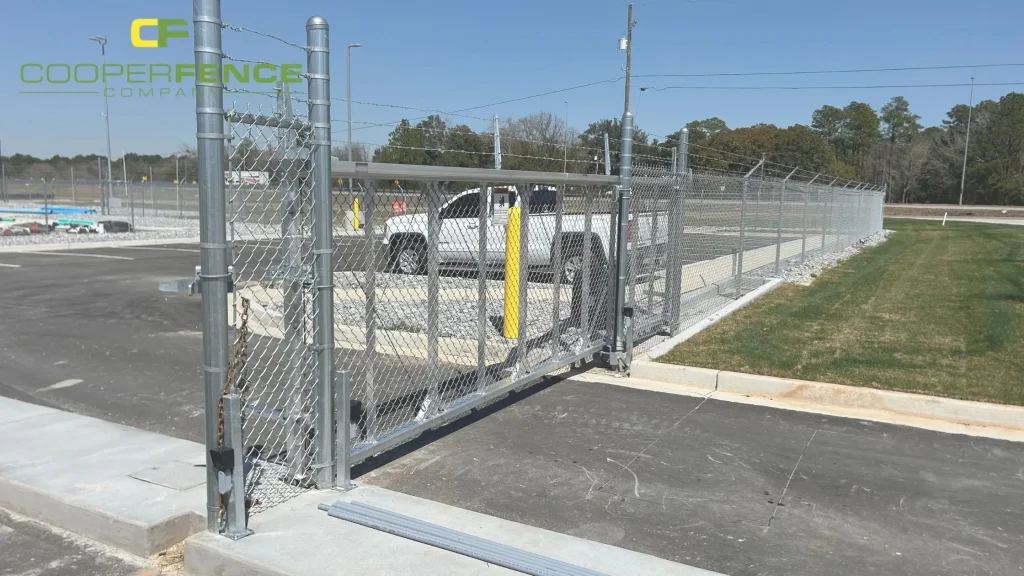
Slide gates move horizontally along a track parallel to the fence line and are the preferred choice for high-traffic industrial entrances where the available space does not accommodate the arc of a swinging gate. They handle heavy gate weights well, operate reliably under high cycle frequencies and are a strong choice for facilities where vehicles are entering and exiting throughout the day on a continuous basis.
Swing gates operate by pivoting on hinges and swinging inward or outward to open. They are appropriate for lower-traffic access points and applications where there is adequate clearance for the gate to swing without obstruction. Swing gates can be configured as single or bi-parting panels and are often used for pedestrian access points alongside a primary slide gate vehicle entrance.
Operator Sizing and Duty Cycle
Gate operators are rated for the weight of the gate they are designed to move and the duty cycle they can sustain. Duty cycle refers to how frequently the operator can cycle, meaning open and close a gate, within a given period without overheating or sustaining damage.
For industrial facilities with continuous vehicle traffic, a commercial or industrial-duty operator with a high duty cycle rating is essential. A residential-grade operator installed on a heavy industrial gate will fail quickly under the kind of cycle frequency a busy facility imposes, and the downtime associated with operator failure at a primary entrance creates both security and operational problems that are disproportionate to the cost difference between an appropriately specified operator and an undersized one.
Cooper Fence’s team works with facility managers and general contractors to specify gate operators that are correctly sized for the gate weight, the traffic volume and the duty cycle requirements of the specific application. This is a technical conversation that benefits from experience, and it is one the Cooper Fence team is equipped to have from the first site assessment.
Access Control Integration
Modern industrial gate operators are designed to integrate with a range of access control and security technologies, including keypads and PIN entry systems, proximity card and key fob readers, vehicle loop detectors that sense approaching vehicles and trigger automatic opening, intercom systems for visitor management, surveillance camera integration and remote monitoring and control capabilities.
The right combination of access control features depends on the security profile of the facility and the operational requirements of the access point. A logistics facility where dozens of trucks enter and exit daily has different requirements than a utility substation that needs to log and restrict access to a limited set of authorized personnel. Designing the gate system around the actual operational and security requirements of the facility rather than defaulting to a generic configuration is what separates a well-specified industrial gate system from one that creates as many problems as it solves.
Safety Requirements for Industrial Gate Systems
Industrial gate operators must meet specific safety standards to comply with applicable codes and to protect employees, contractors and visitors from the hazards associated with heavy automated gates. Edge sensors that stop and reverse gate movement when an obstruction is detected, warning signs and audible alerts that signal gate movement, proper clearances around the gate travel path and entrapment protection devices are all safety requirements that a professional installation addresses as a matter of standard practice.
For facility managers, the safety compliance of the gate system is not just an ethical obligation. It is a liability management issue. An improperly installed or non-compliant gate operator that causes an injury creates legal exposure that far exceeds the cost of a properly specified and installed system.
Cooper Fence is a member of the American Fence Association and the Associated General Contractors of America, reflecting the professional standards the company brings to every installation including the safety compliance requirements associated with industrial gate systems.
Planning an Industrial Fencing and Gate Project
Industrial fencing and gate projects benefit from early, detailed planning. The site assessment, the fence specification, the gate layout, the operator selection and the access control integration all need to work together as a system rather than being pieced together from independent decisions made at different points in the project.
Cooper Fence brings this systems perspective to industrial fencing projects across the Gulf Coast, with the experience to help facility managers and general contractors make the right decisions at each stage of the project. Our local warehouse keeps inventory available to support project timelines and minimizes the delays that can occur when materials have to be sourced from distant suppliers.
For facilities on or near the Gulf, our coastal environment adds an additional layer of specification consideration around corrosion resistance and coating selection that Cooper Fence’s team understands from decades of installation experience in the region.
For commercial fencing needs that fall outside the industrial category but still require a higher level of specification and performance than standard residential fencing, Cooper Fence’s commercial fencing services cover the full range of applications.
Ready to discuss an industrial fencing or gate operator project for your facility? Request a free quote from Cooper Fence today or call (251) 367-1980 to speak with the team about your facility’s specific security and access control requirements.
Frequently Asked Questions
What chain link gauge is recommended for industrial security fencing?
Industrial security applications typically require a minimum of 9 gauge chain link wire, with 6 gauge wire used in higher-security environments where the fence needs to resist cutting tools or sustained physical pressure. Standard residential chain link at 11 or 11.5 gauge is not appropriate for industrial security applications where the fence is expected to deter or delay unauthorized entry. Our team can help you determine the right gauge specification for your facility’s specific security requirements during the project assessment.
What is the difference between a slide gate and a swing gate for an industrial facility?
Slide gates move horizontally along a track parallel to the fence line and are the preferred choice for high-traffic industrial entrances where space does not accommodate the arc of a swinging gate. They handle heavy gate weights well and operate reliably under high cycle frequencies. Swing gates pivot on hinges and are appropriate for lower-traffic access points or pedestrian entrances where adequate clearance is available. The right choice depends on the specific application, the traffic volume the gate needs to handle and the space available at the access point.
What is a duty cycle rating for a gate operator and why does it matter for industrial applications?
Duty cycle refers to how frequently a gate operator can open and close a gate within a given period without overheating or sustaining mechanical damage. Industrial facilities with continuous vehicle traffic require operators with high duty cycle ratings that are designed for frequent cycling throughout the day. A residential or light-commercial-grade operator installed on an industrial gate will fail quickly under the cycle frequency a busy facility imposes, creating security gaps and operational disruptions that are disproportionate to the cost difference between a properly specified operator and an undersized one.
What access control options can be integrated with an industrial gate operator?
Industrial gate operators can be integrated with a wide range of access control technologies including keypad and PIN entry systems, proximity card and key fob readers, vehicle loop detectors, intercom systems, surveillance cameras and remote monitoring and control capabilities. The right combination depends on the security profile of the facility and the operational requirements of each access point. Cooper Fence can help assess your facility’s requirements and specify a gate system that integrates appropriately with your existing or planned security infrastructure.
Does Cooper Fence handle the permits and compliance requirements for industrial fencing projects?
Cooper Fence works with facility managers and general contractors on the permitting and compliance considerations associated with industrial fencing projects, drawing on decades of experience with fencing installations across Mobile, Baldwin County and the Pensacola area. As a member of the American Fence Association and the Associated General Contractors of America, the company operates to professional standards that include compliance with applicable safety requirements for automated gate systems. Contact the team at (251) 367-1980 to discuss the specific permitting and compliance requirements for your facility’s project.